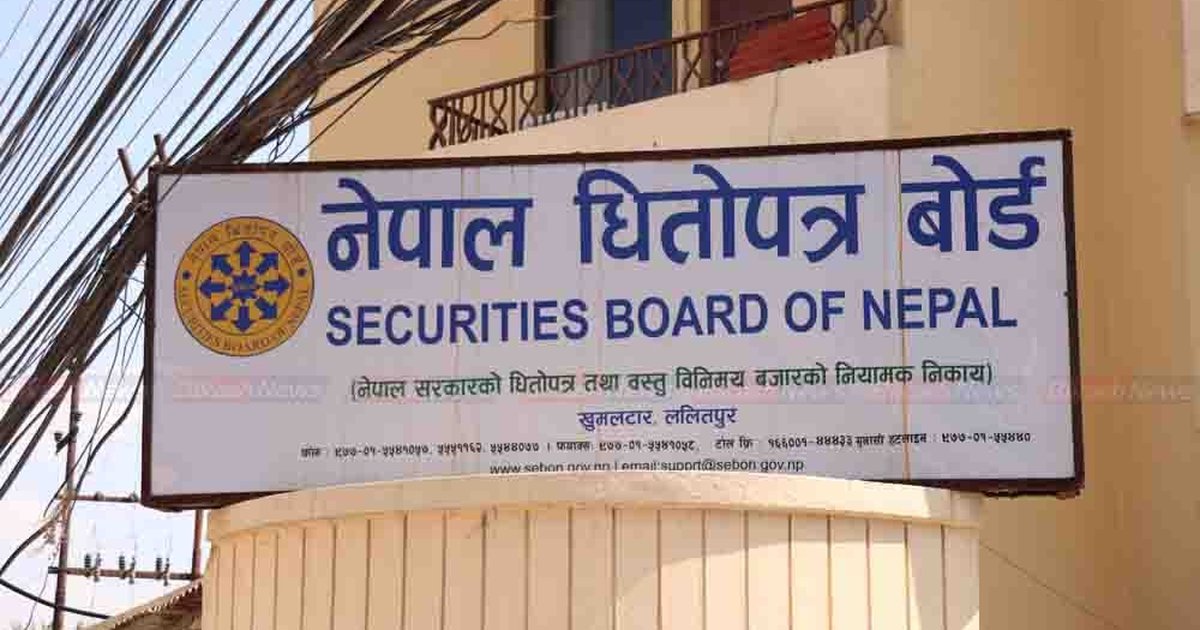
For years, keeping dirty money out of Nepal's share market has been everybody's stated concern and nobody's documented job. SEBON's new directive changes the second half of that sentence. The Directive on Prevention of Money Laundering and Financing of Terrorist Activities, 2083, in force since Ashwin 30, 2083 (October 16, 2026), gives the securities market's reporting entities a binding framework to systematise — SEBON's own word — their work against money laundering and terrorist financing. It is the least dramatic document in the market this month, and possibly the most consequential: integrity stops being a value that firms profess and becomes a procedure they must be able to show.
What actually happened
The facts come from SEBON itself. Its press release, dated 2083/06/30 and signed by spokesperson Niranjaya Ghimire, states that the directive is made under the Asset (Money Laundering) Prevention Act, 2064, that it has been implemented from 2083/06/30, and that all concerned reporting entities have been communicated for its necessary implementation; the directive itself has been placed on SEBON's official website, sebon.gov.np. ShareSansar's report of the announcement corroborates each of those points. SEBON's stated purpose is to further regulate and systematise the activities of reporting entities involved in the securities market, so that institutions operating within it maintain appropriate systems and procedures against the misuse of the financial system.
| Item | Position |
|---|---|
| Instrument | Directive on Prevention of Money Laundering and Financing of Terrorist Activities, 2083 |
| In force | Ashwin 30, 2083 (October 16, 2026) |
| Legal basis | Asset (Money Laundering) Prevention Act, 2064 |
| Who it covers | Reporting entities associated with the securities market |
| What SEBON says it does | Regulates and systematises reporting entities' activities; institutions to maintain appropriate systems and procedures |
| What it is not | Not a finding against any firm, not a price signal, not an enforcement announcement |
What the directive actually requires
The directive text itself, published on sebon.gov.np, is a long document — but its spine is short, and it is worth stating plainly, because this is where "systematise" stops being a slogan. Issued under the Asset (Money Laundering) Prevention Act, 2064, the Securities Act, 2063 and the Commodities Exchange Act, 2074, it binds reporting entities — licensed securities and commodities businesses, and the exchanges themselves for over-the-counter trading — to the following:
| Obligation | What it means in practice |
|---|---|
| Risk-based internal policies (§3) | Internal policies and procedures built on risk assessment: staff responsibility and division of work, a risk-assessment system and method, risk-based customer identification, verification, updating and monitoring, and a system for identifying unusual and suspicious transactions. |
| Customer identification (§4) | Identify and verify customers under the Act and the 2081 Regulations, using citizenship or national ID electronic records; business relationships with Nepali citizens to be established on a national-ID basis; biometric collection from the account holder (natural persons) and from all directors (legal persons); customer details kept in integrated electronic form. |
| Listed-person freeze and report (§5) | Screen continuously against the published lists of listed persons, groups and organisations; freeze any securities account, securities, funds or assets of a listed person immediately under the targeted-financial-sanctions procedure; report a freeze to SEBON within 3 days (and a release likewise), with a copy to the Financial Information Unit. |
| Politically exposed persons (§6) | Mechanisms to identify PEPs when accounts are opened, transactions are done and details are updated — including family and associates — with categories for in-office, former, foreign and international-organisation PEPs; PEP records kept for at least 10 years after leaving office or the end of the relationship; national-ID details of all PEP customers to be updated within 6 months of the directive. |
| Beneficial owners (§7) | Mechanisms to identify the real beneficial owner and to monitor that owner's transactions in integrated form; beneficial-owner records kept for 5 years after the business relationship or transaction ends. |
| Institutional risk report (§8) | An institutional risk identification, assessment, analysis and management report, covering customer, service, geographic and delivery-channel risk, submitted to SEBON within the first quarter after each fiscal year ends; the institutional risk assessment itself independently reviewed by a third party every year. |
Two things stand out in that list. First, the directive's definitions also sweep in investment companies — firms set up to invest in securities with Rs 5 crore or more of paid-up capital, or Rs 10 crore or more of annual securities transactions — the same thresholds by which SEBON became their regulator. Second, nothing in the list is a one-off filing: every obligation is a standing system (identify, monitor, update, report, retain) with a clock attached — 3 days for a freeze report, 6 months for the PEP identity update, 5 and 10 years for record retention, every year for the risk review. That is what "systematise" cashes out as. A firm that cannot produce the file, on time, has not complied — whatever its intentions.
Why the securities market needed a systematised duty
A share market is an unusually convenient place to move money. It is liquid, it is intermediated, and a transaction that looks like an investment decision is difficult to distinguish from one that is not. Nepal's market sharpens that problem: it is dominated by individual traders, as SEBON itself acknowledged when it pushed its institutional-investor policy earlier this year, and its plumbing runs through brokers, merchant bankers, the exchange and the clearing house — each of them a point where a customer is identified, a transaction is recorded, and a suspicion can either be noticed or missed. Under the country's anti-money-laundering framework, securities companies already sit under SEBON as their regulator — the Financial Information Unit's own reporting guidance lists them alongside banks under Nepal Rastra Bank and insurers under the insurance regulator. The directive does not invent that architecture. It turns it from a set of expectations into a documented, auditable obligation for the market's own institutions.
That distinction matters more than it sounds. An expectation can be met with a policy document and a training session. An obligation that must be systematised has to survive an inspection: are customers identified, are transactions monitored against risk, are suspicious matters reported through the proper channel, are records kept? The standard anti-money-laundering toolkit — customer identification, risk-based monitoring, reporting to the Financial Information Unit, and record-keeping — is not new law. What is new is SEBON telling its reporting entities, in a binding directive with an in-force date, that having the toolkit is no longer optional or informal. The market's integrity stops being a matter of each firm's good faith and starts being a matter of each firm's files.
Why now: the grey list and the predicate-offence net
The directive does not arrive in a vacuum. In February 2025 the Financial Action Task Force placed Nepal on its list of jurisdictions under increased monitoring — the grey list — for strategic deficiencies in its anti-money-laundering and counter-terrorist-financing regime, and Nepal was still listed in the FATF's October 2025 update, described as progressing on its action plan. A grey listing is not a sanction and it does not block trading, but it raises the cost of every cross-border financial relationship the country touches, and it puts every regulator's homework under international light. SEBON's directive is, in that light, homework being handed in: evidence that the securities regulator is closing a gap in its own sector rather than waiting for the next evaluation to find it.
The net has widened in parallel. The Asset (Money Laundering) Prevention (Third Amendment) Ordinance, 2083, summarised by InfinityNP, brings market manipulation adversely affecting the securities market and insider trading within the investigation remit for money-laundering offences — the conduct the market usually discusses as a fairness problem is now also, formally, a predicate for a financial-crime investigation. Read together, the two moves describe a single direction: the market's old misbehaviour categories are being wired into the anti-money-laundering machine, and the market's institutions are being told to build the wiring. Neither move accuses any particular participant. Both raise the price of assuming nobody will ever check.
What investors should — and should not — read into this
First, what it is not. The directive is not a verdict on any broker, merchant banker or listed company, and nothing in SEBON's public description suggests an enforcement action against a named firm. It is not a signal about any stock's price, and it is not a reason to buy or sell anything. Any commentary that turns a compliance directive into a tip — about a firm that will be "cleaned up" or a stock that will benefit — is inventing a story the directive does not tell.
Second, what it is. For ordinary investors, the practical effect should be unglamorous: more questions when an account is opened, more consistency in what brokers ask for, and fewer firms where the answer to "how do you check?" is a shrug. That is a feature, not a bug — and it is also a test investors can apply themselves. A market where every intermediary can show its customer-identification and monitoring procedures is a market where an honest investor's money is harder to confuse with anyone else's. The directive's real audience is not the investor at all; it is the compliance officer, the auditor and the supervisor who will now ask to see the files.
Third, what to watch. A directive is only as strong as its supervision. The honest test of this one is not its in-force date but what follows: whether SEBON inspects reporting entities against it, whether it publishes guidance on what "appropriate systems" means in practice, and whether firms' reporting to the Financial Information Unit changes in volume or quality. If none of that follows, the directive will join the shelf of well-drafted documents the market already owns. If it does follow, the cost structure of running a securities business in Nepal changes — compliance becomes a fixed cost of staying in business, and firms that treated it as optional will find the market a less comfortable place. Either way, the investor's job is unchanged: judge companies on their business, and judge the market on whether its rules are enforced, not merely announced.
Nepal's market has spent years debating whether its problem is bad rules or bad enforcement. This directive answers the first half for one corner of the system. The second half — supervision, inspection, and the willingness to act on what the files show — is the part no directive can deliver by itself. That is where this story will actually be decided, and where anyone watching the market should keep looking.
Frequently asked questions
What is SEBON's AML directive, 2083, and when did it take effect?
The Directive on Prevention of Money Laundering and Financing of Terrorist Activities, 2083, made under the Asset (Money Laundering) Prevention Act, 2064. SEBON's press release dated 2083/06/30 states it has been implemented from 2083/06/30 — Ashwin 30, 2083 (October 16, 2026) — and that all concerned reporting entities have been communicated for implementation; the directive is placed on sebon.gov.np.
Who has to comply with the directive?
Reporting entities associated with Nepal's securities market — the institutions SEBON regulates, including securities companies (brokers and related firms). Under the Financial Information Unit's reporting framework, securities companies fall under SEBON as regulator, just as banks fall under Nepal Rastra Bank.
Does the directive affect ordinary investors directly?
Not as a trading rule: it imposes no new obligation on investors to buy, sell or hold anything. Its practical effect for investors should be more consistent customer-identification and monitoring questions from intermediaries — the compliance work sits with the reporting entities, not with account holders.
Is the directive aimed at a specific broker, company or stock?
No. Nothing in SEBON's public description names a firm or an enforcement action, and nothing in it is a price signal. It is a framework directive for the whole securities market, and reading it as a tip about any named security would be inventing a story it does not tell.
Why did SEBON issue this directive now?
Context, not a stated reason: Nepal has been on the Financial Action Task Force's increased-monitoring (grey) list since February 2025, and the Asset (Money Laundering) Prevention (Third Amendment) Ordinance, 2083 has widened the money-laundering net to include market manipulation and insider trading as predicate offences. The directive systematises the securities sector's own compliance within that tightening framework.
Where can I read the directive itself?
SEBON has placed the directive on its official website, sebon.gov.np, as its press release states — the Nepali-language directive text (PDF) is published there. The obligations summarised in this article are taken from that text; it is the operative document.
Sources: SEBON press release dated 2083/06/30, signed by spokesperson Niranjaya Ghimire and published on sebon.gov.np (directive name, Asset (Money Laundering) Prevention Act, 2064 basis, implementation from 2083/06/30, communication to all concerned reporting entities, directive placed on sebon.gov.np); the directive text itself, published on sebon.gov.np (issuing authorities, definitions, and sections 3–8 summarised above; Nepali-language PDF); corroborated by ShareSansar's report of the announcement; Financial Action Task Force February 2025 plenary outcome and October 2025 increased-monitoring update (Nepal listed, progressing); Financial Information Unit's suspicious-transaction reporting guidance (securities companies under SEBON as regulator); InfinityNP's summary of the Asset (Money Laundering) Prevention (Third Amendment) Ordinance, 2083 (market manipulation and insider trading as predicate offences). Note on the date: Ashwin 30, 2083 converts to October 16, 2026 on the Nepali calendar (Ashwin 2083 runs September 17 to October 17, 2026). No firm is named as under investigation, no broker impact figure is claimed, and no price or market effect is predicted. This article is published for research and education purposes only. It is not investment advice, and nothing here should be read as a recommendation to buy, sell, or hold any security.