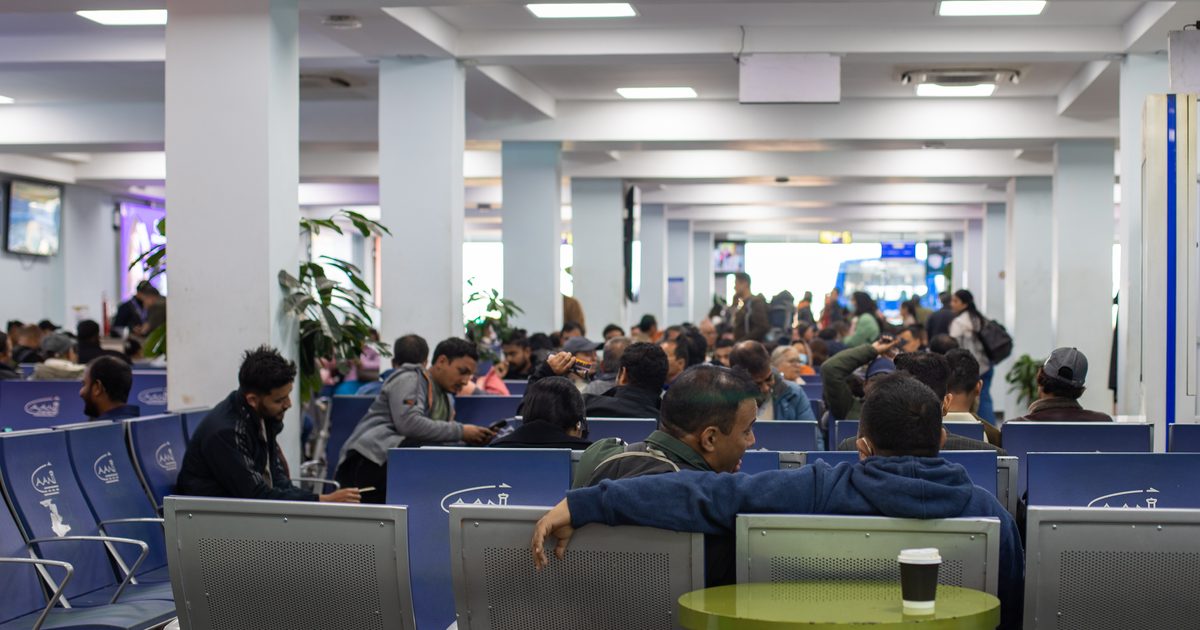
In the fiscal year that ended in mid-July 2026, Nepal ran a current account surplus equal to 14 percent of its GDP. The World Bank's October 2026 Nepal Development Update calls it a record, double the previous year's level. Remittance inflows reached 35.8 percent of GDP. Foreign exchange reserves climbed to USD 25.3 billion, enough to cover 19.6 months of imports, nearly three times the central bank's own 7-month minimum. Inflation fell to a record low of 3.1 percent. These are the strongest external numbers Nepal has ever posted. Every one of them rests on the same fact: the money sent home by Nepalese working abroad.
The detail that should stop you is this: remittances grew even though 19.6 percent fewer Nepalese took new approvals for foreign employment. The World Bank attributes the rise to higher remittances per worker, diversification of destination countries, depreciation of the Nepali rupee against the US dollar, and wider use of formal and digital transfer channels. In plain terms, the stock of workers already abroad is sending more money, through better pipes, in a weaker currency that converts each dollar into more rupees at home.
This is why the surplus sits oddly beside the trade numbers. The trade deficit widened, because imports of intermediate goods and fuel grew faster than exports. Exports of goods and services did increase, the update notes refined soybean oil re-exports to India alongside growth in professional and management consulting and ICT services, but nowhere near enough to close the gap. What closed it was labor, exported in person. Nepal's largest export does not appear on any customs form.
The surplus is real. So is everything it hides.
Set the external numbers against the domestic ones in the same report and the picture changes. Private sector credit barely moved, from 95.7 percent of GDP to 95.9 percent, even though Nepal Rastra Bank cut its policy rate to 4.25 percent and banks sat on persistent excess liquidity through the year. Money was cheap and available. Borrowers still did not come. That is a demand problem, not a price problem, and rate cuts cannot fix it.
Bank balance sheets tell the same story from the other side. The gross non-performing loan ratio reached a record 5.7 percent by mid-July 2026, with deterioration across all major categories of financial institutions. Loan-loss provisions rose by 0.1 percentage point of GDP to 1.2 percent, and financial sector profits slipped on weaker net interest income. Capital buffers held, with the aggregate capital adequacy ratio at 12.8 percent against an 11 percent regulatory minimum, but the direction of travel is wrong.
The fiscal picture offers no relief either. The deficit widened marginally to 1.7 percent of GDP while capital expenditure execution fell to a record low of 46.8 percent: the government could not spend even half of its development budget, partly because of disruptions following the September 2025 unrest. Public debt rose to 45.1 percent of GDP from 43.0 percent. And growth itself slowed to 3.9 percent from 4.4 percent, as agricultural growth collapsed to 1.6 percent on a 4.2 percent contraction in paddy production.
A flood on top of a fragile structure
Then came August. On August 26, 2026, a glacially triggered flood in the Rasuwagadhi corridor tore through Rasuwa, Nuwakot, and Dhading districts. The national disaster authority counted 1,453 dead and 5,285 missing as of September 26. The World Bank's rapid damage estimation puts direct damage to physical assets at USD 1.66 billion, close to the government's own USD 1.81 billion assessment, with total disaster effects near USD 2.7 billion and recovery needs around USD 4.8 billion. Energy took the worst of it: roughly 430.7 MW of generation and transmission capacity was affected, about 10.6 percent of the country's installed hydropower and solar capacity.
The Bank now expects growth to slow further to 3.7 percent in FY27 before recovering to 5.2 percent in FY28 as reconstruction gathers pace. The current account surplus is expected to narrow as reconstruction imports rise and tourism receipts soften, while inflation should stay contained near the central bank's 5 percent target, though localized crop losses could press hardest on poorer households. Reserves, the update notes, should remain comfortably above the regulatory minimum, supported by remittances that are expected to stay resilient.
What the record does not answer
A few cautions, stated plainly. A current account surplus is an accounting outcome, not a score for economic health. Part of this record reflects imports that a weak domestic economy simply did not demand. Remittance strength measured in rupees flatters a depreciating currency. And a single year's figures, however striking, describe what happened; they do not dictate what comes next.
The unresolved question is the one the update keeps circling. Nepal's external position has never been stronger, and it has never depended more on its citizens working somewhere else. The reserves, the surplus, the low inflation: all of it flows from departures. If those departures ever slow, whether through policy shifts in destination countries or a domestic recovery that keeps people home, the surplus narrows and the economy underneath has to carry the weight. That economy, the one with record bad loans, stalled credit, and unspent development budgets, is not ready yet. The record is real. So is the fragility it stands on.
This article is published for research and education purposes only. It is not investment advice, and nothing here should be read as a recommendation to buy, sell, or hold any security. Figures cited reflect publicly reported information at the time of writing and may be revised.